 Image 1 of 1
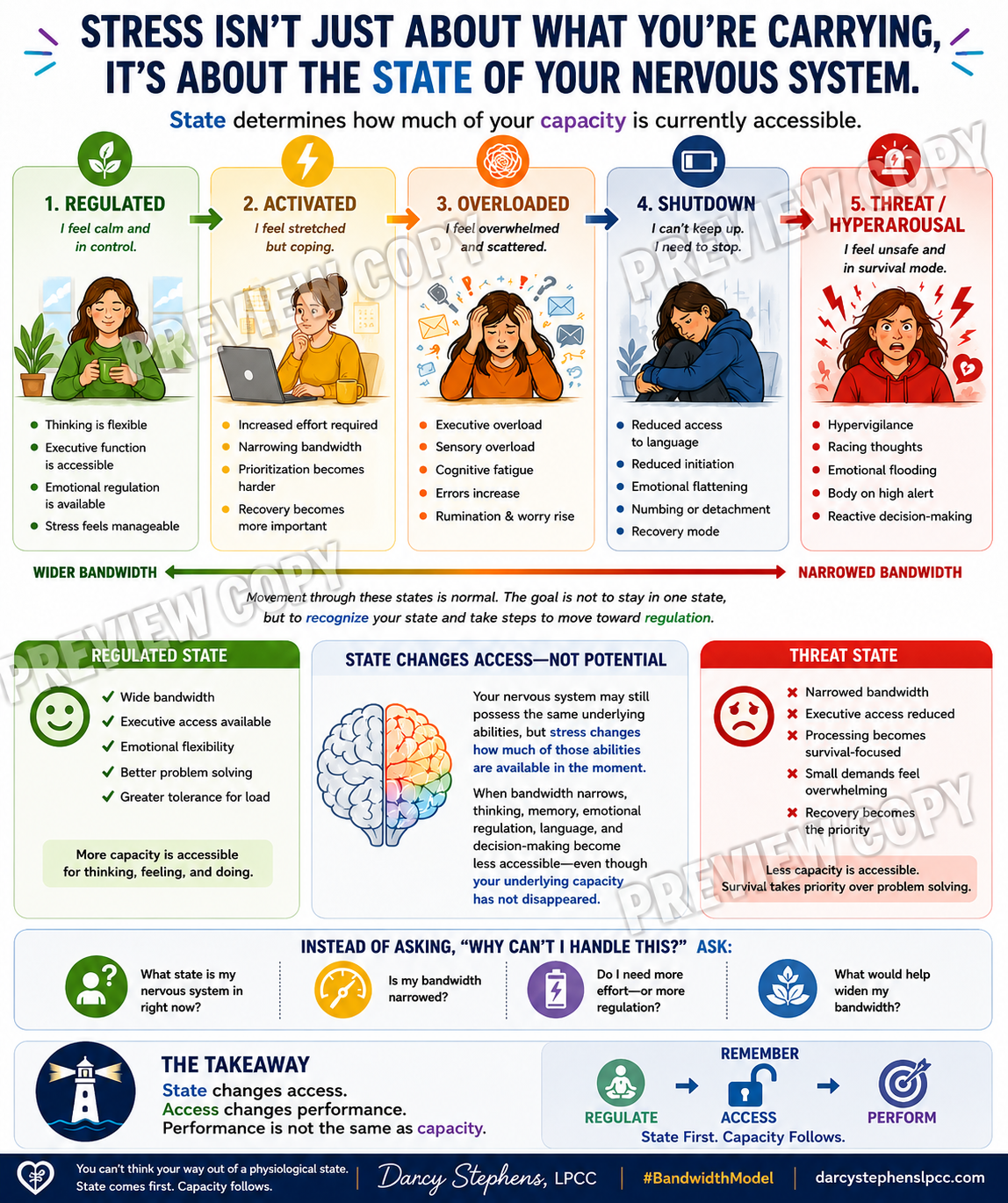
Stress Isn't Just About What You're Carrying—It's About the State of Your Nervous System
Why can the same workload feel manageable one day and impossible the next? This infographic explains how your nervous system's current state influences how much of your underlying capacity is actually available. Using the Bandwidth Model™, it illustrates five common nervous system states—from regulation to hyperarousal, overload, and shutdown—and demonstrates how changes in physiology affect thinking, emotional regulation, executive functioning, decision-making, and recovery. Rather than viewing stress as a reflection of character or resilience, this resource reframes it as the interaction between nervous system state, cumulative load, and available bandwidth.
Designed for clinicians, educators, caregivers, and neurodivergent individuals, this visual offers a practical framework for recognizing state changes, understanding why performance fluctuates, and shifting the focus from self-criticism to regulation and recovery.
Educational resource only. This handout reflects current research and clinical concepts and incorporates the author's Bandwidth Model™, an evidence-informed conceptual framework for understanding how neurodevelopmental architecture, nervous system state, cumulative load, and processing demands influence day-to-day functioning. The Bandwidth Model™ has not yet been empirically evaluated and should be considered a conceptual framework rather than an established scientific model. This resource is intended for educational purposes and should not be used as a substitute for professional medical or mental health evaluation, diagnosis, or treatment.
Stress Isn't Just About What You're Carrying—It's About the State of Your Nervous System
Why can the same workload feel manageable one day and impossible the next? This infographic explains how your nervous system's current state influences how much of your underlying capacity is actually available. Using the Bandwidth Model™, it illustrates five common nervous system states—from regulation to hyperarousal, overload, and shutdown—and demonstrates how changes in physiology affect thinking, emotional regulation, executive functioning, decision-making, and recovery. Rather than viewing stress as a reflection of character or resilience, this resource reframes it as the interaction between nervous system state, cumulative load, and available bandwidth.
Designed for clinicians, educators, caregivers, and neurodivergent individuals, this visual offers a practical framework for recognizing state changes, understanding why performance fluctuates, and shifting the focus from self-criticism to regulation and recovery.
Educational resource only. This handout reflects current research and clinical concepts and incorporates the author's Bandwidth Model™, an evidence-informed conceptual framework for understanding how neurodevelopmental architecture, nervous system state, cumulative load, and processing demands influence day-to-day functioning. The Bandwidth Model™ has not yet been empirically evaluated and should be considered a conceptual framework rather than an established scientific model. This resource is intended for educational purposes and should not be used as a substitute for professional medical or mental health evaluation, diagnosis, or treatment.