


The Bandwidth Model™
Reading Capacity, Not Character
The Bandwidth Model™ is a transdiagnostic, neuroscience-informed framework I developed to help explain why our ability to think, feel, regulate emotions, connect with others, and complete everyday tasks fluctuates over time.
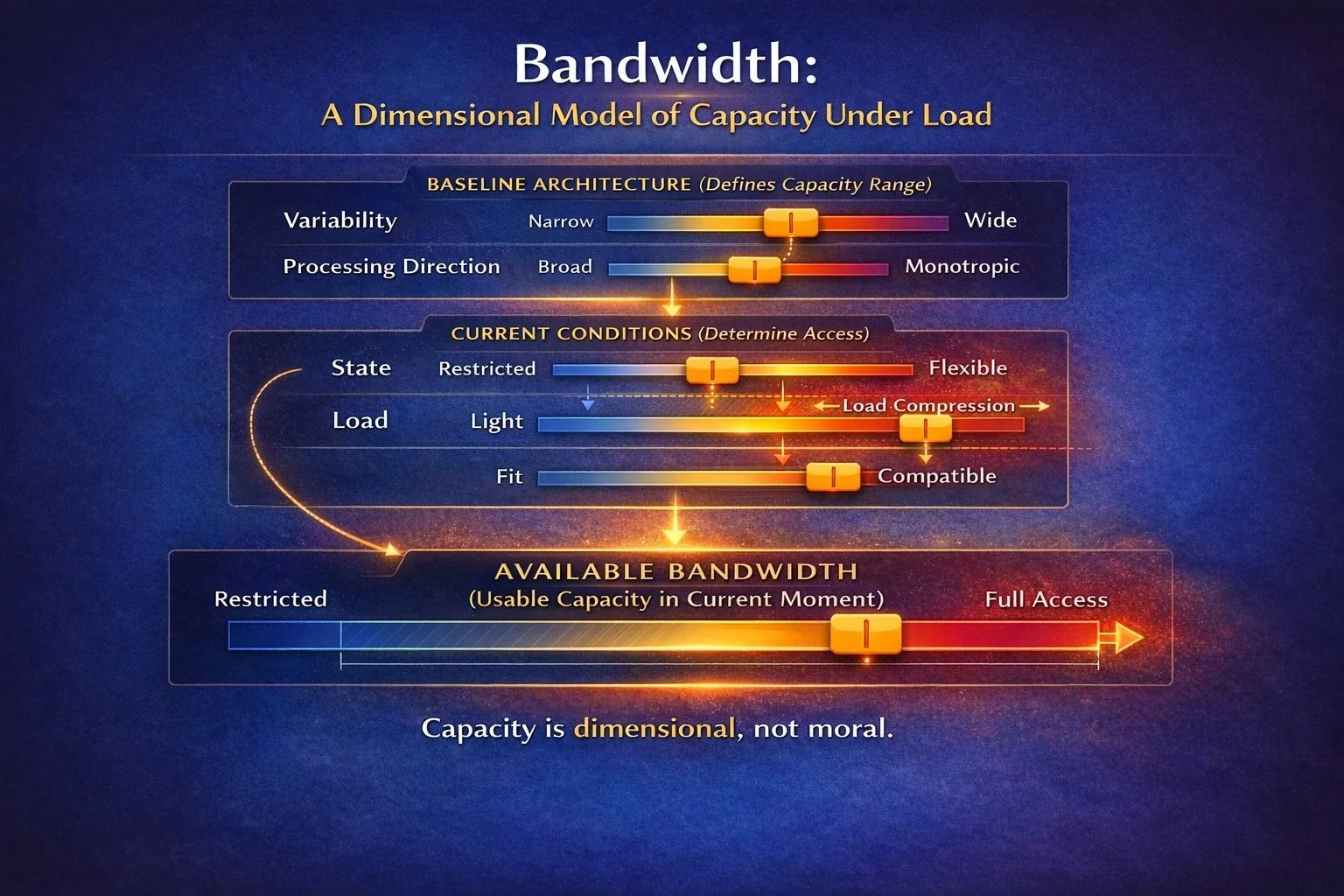
Rather than viewing behavior as simply a matter of motivation, willpower, or personality, the Bandwidth Model proposes that functioning is influenced by the amount of available nervous system capacity a person has at any given moment. Our ability to access our skills, knowledge, emotional regulation, executive functioning, communication, and problem-solving changes continuously as our nervous system responds to both internal and external demands. The model recognizes that people often possess the necessary abilities yet are temporarily unable to consistently access them when their available bandwidth is reduced.
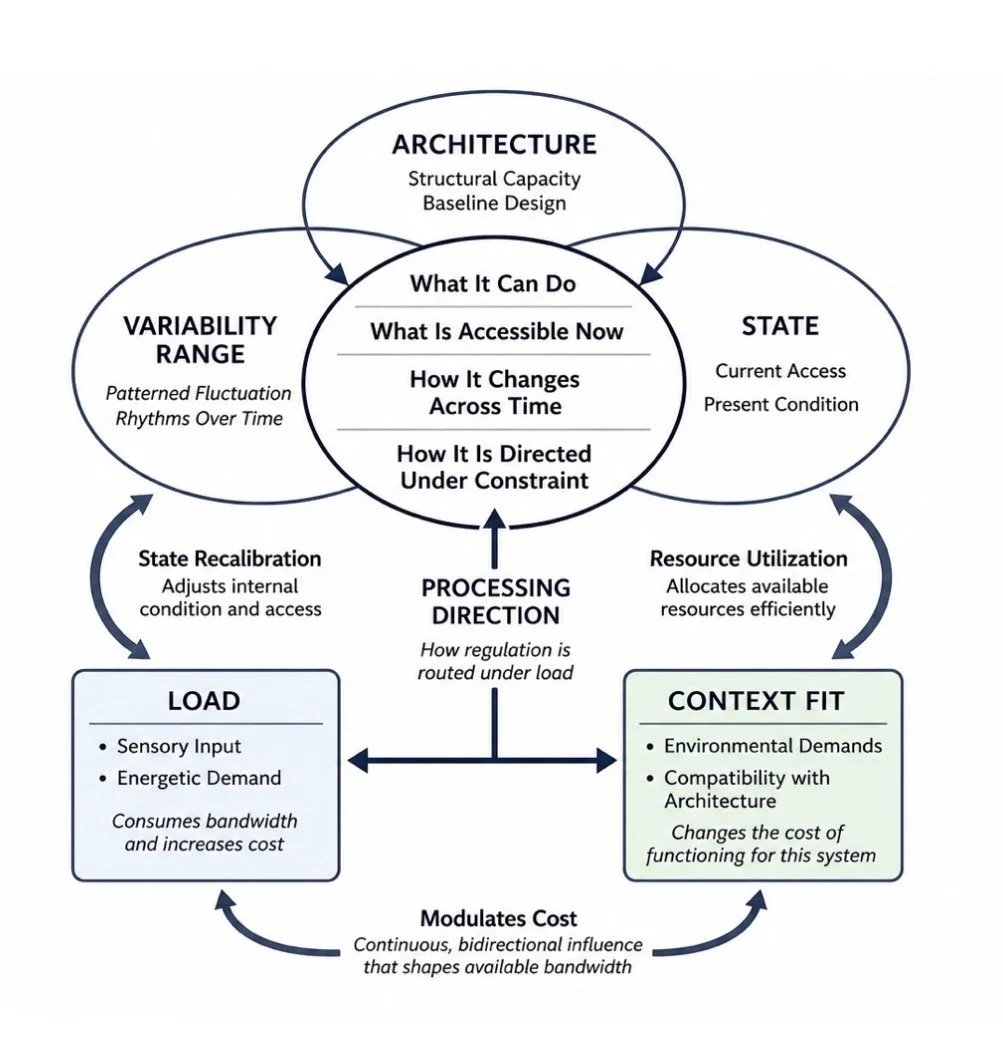
At the heart of the model are the Six Forces of Bandwidth:
Architecture – the unique structure of each person's nervous system, including neurodevelopmental differences such as autism, ADHD, AuDHD, and other individual patterns of processing.
Variability – the natural fluctuations in capacity that occur throughout the day, across situations, and over the lifespan.
Load – the cumulative demands placed on the nervous system, including stress, illness, trauma, sensory input, cognitive effort, sleep, relationships, and environmental factors.
State – the nervous system's moment-to-moment physiological condition, influencing how much of our capacity is currently accessible.
Context Fit – the degree to which our environment, expectations, and supports align with our individual nervous system needs.
Processing Direction – whether information is processed primarily from the "bottom up" (body and sensory experience influencing thoughts and emotions) or the "top down" (thoughts and cognition influencing emotions and behavior), and how these pathways interact.
Rather than operating independently, these six forces constantly interact with one another. A change in one area—such as increased stress, improved sleep, a supportive environment, illness, or sensory overload—can influence the others, resulting in measurable changes in available bandwidth and day-to-day functioning.
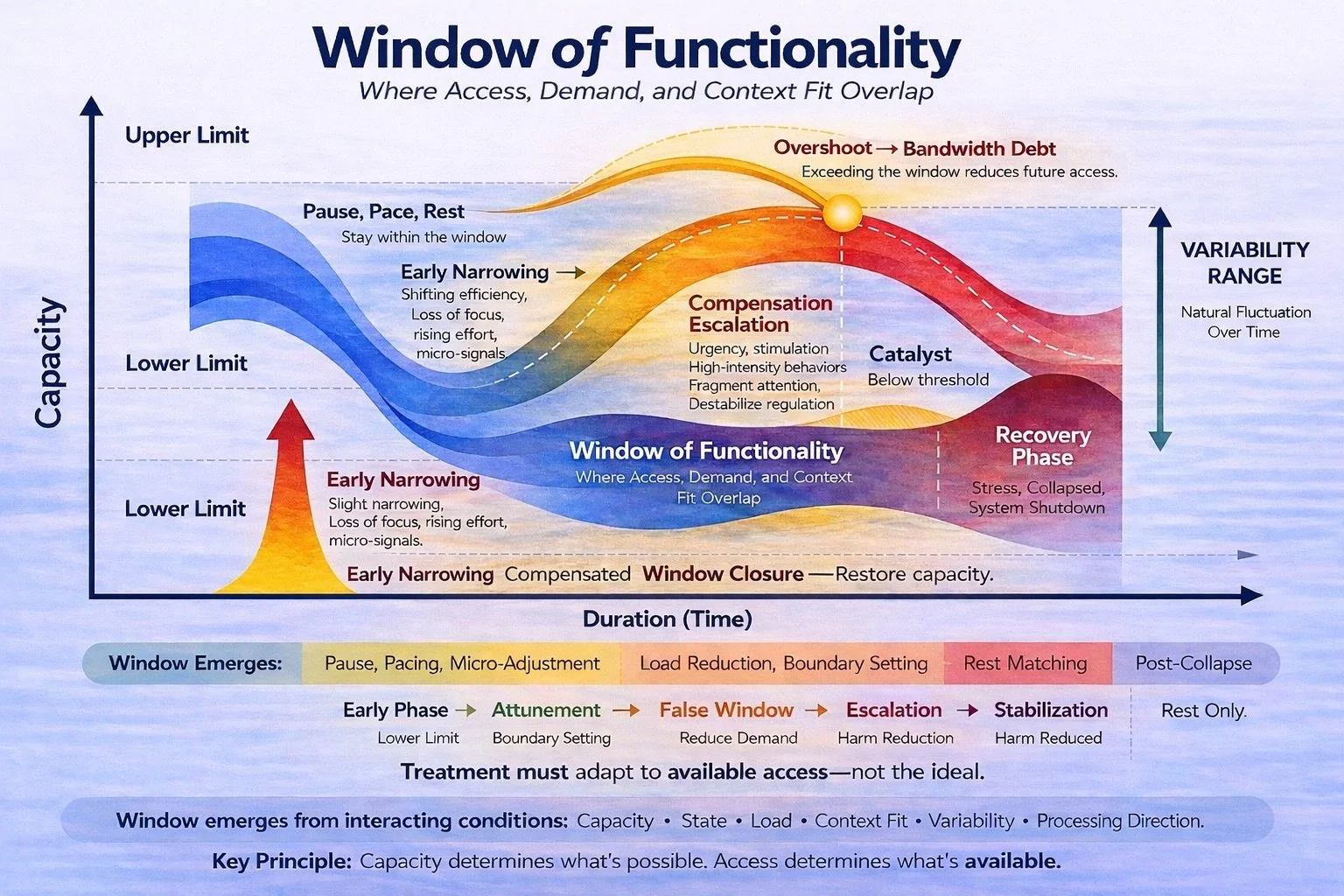
The Bandwidth Model also introduces the Window of Functionality, a dynamic way of understanding human performance. Rather than asking whether someone is simply "functioning" or "not functioning," the model recognizes that people move through predictable states of openness, narrowing, compensation, reduced access, and recovery as available bandwidth changes. This perspective helps explain why executive functioning, emotional regulation, communication, daily living skills, learning, and social engagement may fluctuate—even within the same person.
Because it focuses on underlying nervous system capacity rather than diagnosis alone, the Bandwidth Model is transdiagnostic. It can be applied across autism, ADHD, trauma, anxiety, depression, chronic illness, burnout, neurodegenerative conditions, and many other physical and mental health presentations by examining the common mechanisms that influence access to functioning rather than viewing each diagnosis in isolation.
Rather than replacing existing diagnostic frameworks or evidence-based treatments, the Bandwidth Model is intended to complement them by offering a shared conceptual framework for understanding why functioning changes over time. It integrates current knowledge from neuroscience, psychology, neurodevelopment, stress physiology, and nervous system regulation into a practical model that can be applied across clinical care, education, workplaces, caregiving, and everyday life.
Ultimately, the Bandwidth Model shifts the question from "What's wrong with this person?" to "What is happening to their available capacity right now?" This shift encourages a more compassionate, accurate, and practical understanding of human functioning. By recognizing that capacity is dynamic rather than fixed, the model helps individuals, families, educators, healthcare professionals, and organizations make decisions that better support regulation, sustainable functioning, and long-term well-being.
The Bandwidth Model™
© 2026 Darcy L. Stephens. All rights reserved.