

 Image 1 of 1
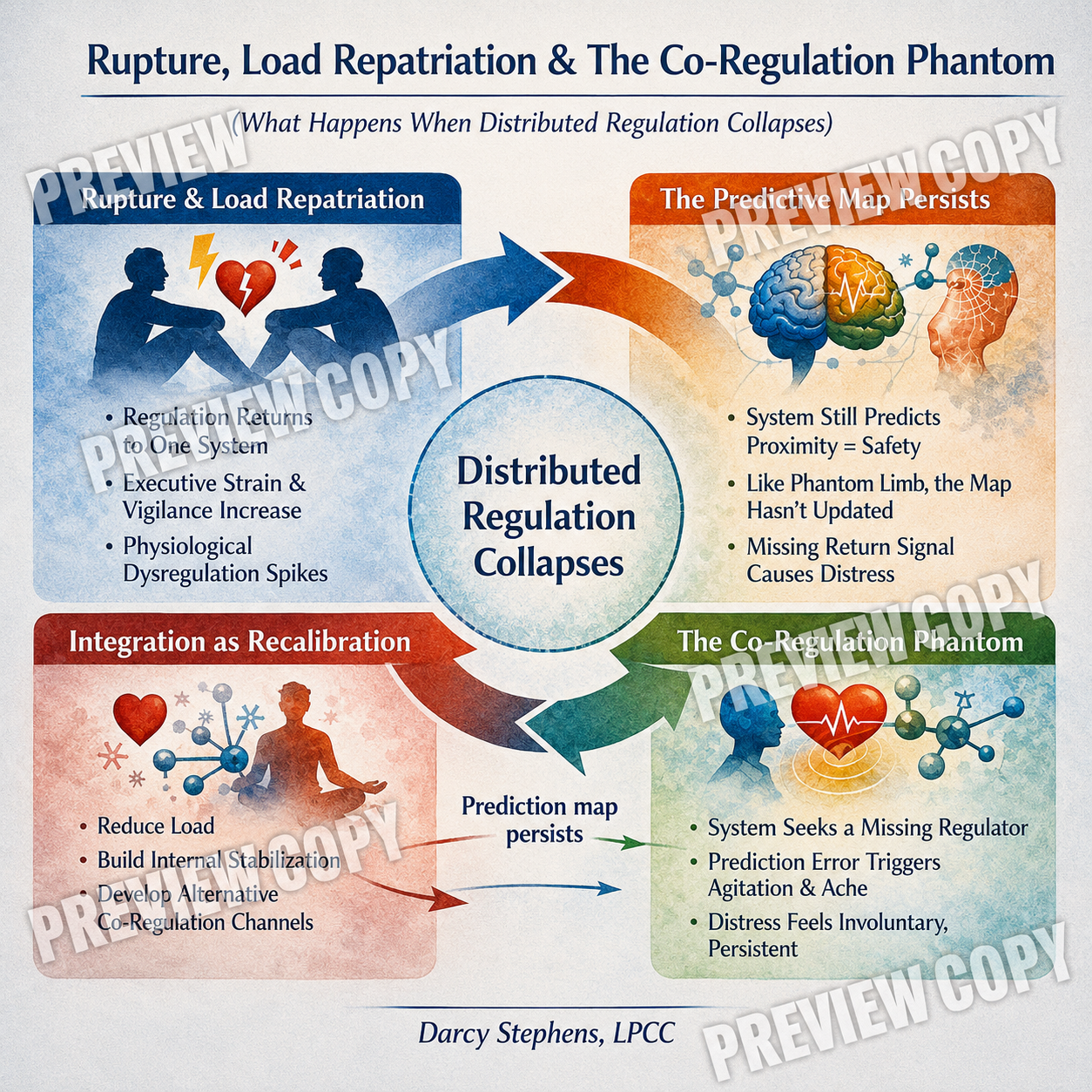
What happens when a relationship becomes part of your nervous system's regulation and that connection suddenly ends? This visual illustrates the Bandwidth Model™ concept of load repatriation—the process by which regulatory demands that had been distributed across two people abruptly return to one nervous system following rupture. It explores how predictive learning can continue to associate a former relationship with safety, creating a persistent expectation of co-regulation even after the relationship has ended. The concept of the Co-Regulation Phantom provides a framework for understanding why distress, longing, hypervigilance, and the feeling that "something is missing" may persist despite knowing the relationship is over. The graphic also outlines recovery as a process of recalibrating predictive maps, rebuilding internal regulation, and developing new pathways for safety and stability.
Educational resource only. This handout presents the author's Bandwidth Model™, an evidence-informed conceptual framework for understanding how neurodevelopmental architecture, cumulative load, nervous system state, attachment, predictive processing, and co-regulation interact to influence day-to-day functioning. The Bandwidth Model™ has not yet been empirically evaluated and should be considered a conceptual framework rather than an established scientific model. This resource is intended for educational purposes and should not be used as a substitute for professional medical or mental health evaluation or treatment.
What happens when a relationship becomes part of your nervous system's regulation and that connection suddenly ends? This visual illustrates the Bandwidth Model™ concept of load repatriation—the process by which regulatory demands that had been distributed across two people abruptly return to one nervous system following rupture. It explores how predictive learning can continue to associate a former relationship with safety, creating a persistent expectation of co-regulation even after the relationship has ended. The concept of the Co-Regulation Phantom provides a framework for understanding why distress, longing, hypervigilance, and the feeling that "something is missing" may persist despite knowing the relationship is over. The graphic also outlines recovery as a process of recalibrating predictive maps, rebuilding internal regulation, and developing new pathways for safety and stability.
Educational resource only. This handout presents the author's Bandwidth Model™, an evidence-informed conceptual framework for understanding how neurodevelopmental architecture, cumulative load, nervous system state, attachment, predictive processing, and co-regulation interact to influence day-to-day functioning. The Bandwidth Model™ has not yet been empirically evaluated and should be considered a conceptual framework rather than an established scientific model. This resource is intended for educational purposes and should not be used as a substitute for professional medical or mental health evaluation or treatment.