 Image 1 of 1
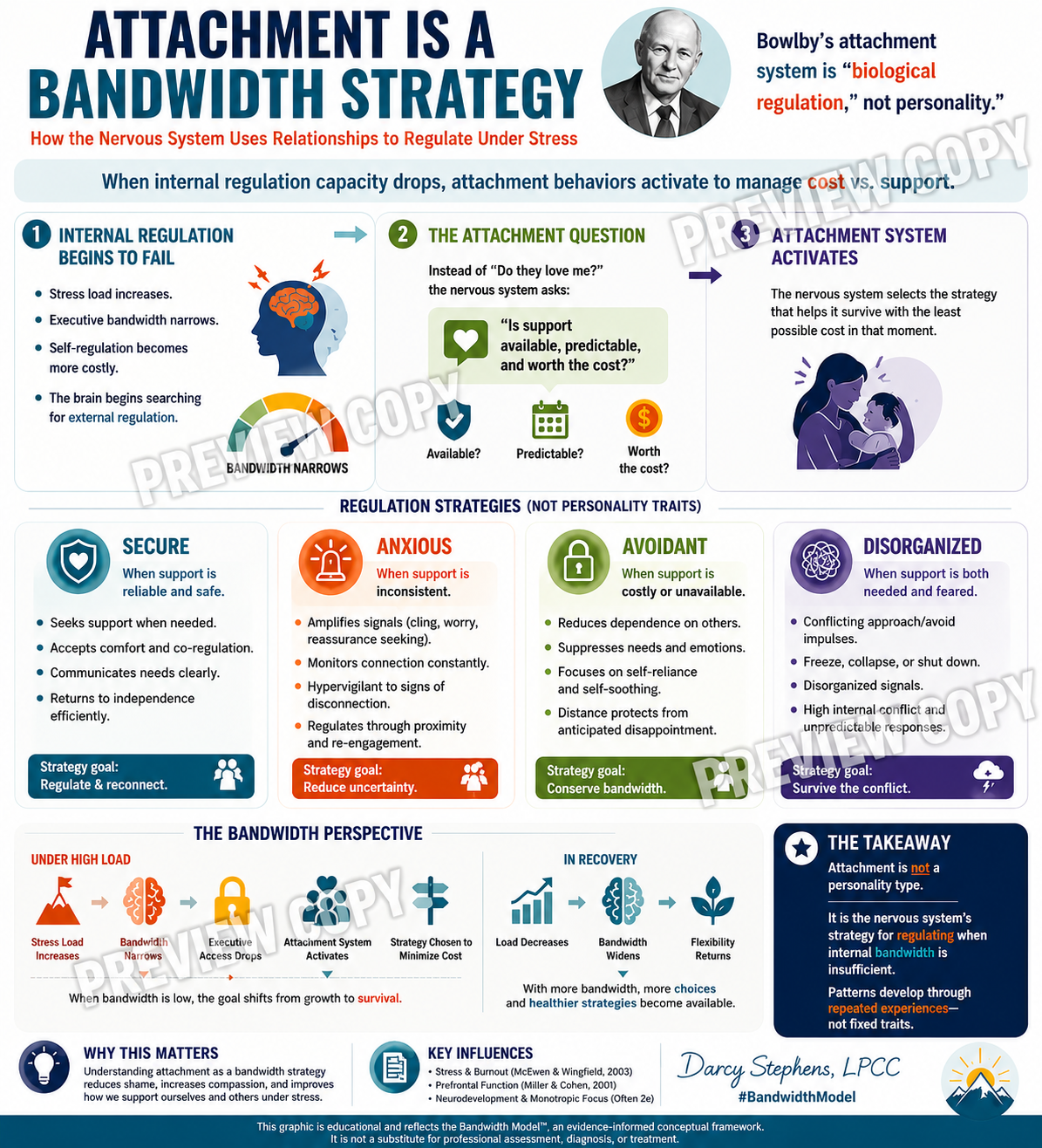
Attachment Is a Bandwidth Strategy: How the Nervous System Uses Relationships to Regulate Under Stress explores attachment through a nervous system and capacity-based lens. Rather than viewing attachment patterns as fixed personality traits, this infographic explains how attachment behaviors can emerge as adaptive regulation strategies when internal bandwidth becomes limited.
This resource illustrates how increasing stress load can narrow executive access, increase the need for external regulation, and activate attachment strategies designed to manage the balance between cost and support. It reframes attachment from “who someone is” to how a nervous system attempts to maintain safety and regulation under changing conditions.
Inside you'll explore:
Why attachment is a biological regulation system rather than simply a personality characteristic.
How stress and reduced internal regulation capacity activate attachment behaviors.
The central attachment question:
“Is support available, predictable, and worth the cost?”
How secure, anxious, avoidant, and disorganized attachment strategies can be understood as adaptations to different relational environments.
The difference between attachment strategies and identity-based labels.
How increased bandwidth allows greater flexibility, connection, and healthier regulation strategies.
Attachment strategies are presented as:
Secure — Support is reliable and safe
Seeks support when needed.
Accepts comfort and co-regulation.
Returns to independence efficiently.
Anxious — Support is inconsistent
Amplifies signals for connection.
Monitors relational availability.
Attempts to reduce uncertainty.
Avoidant — Support is costly or unavailable
Conserves emotional resources.
Minimizes dependence.
Relies heavily on self-regulation.
Disorganized — Support is both needed and feared
Experiences competing approach/avoid responses.
May shift between seeking and withdrawing.
Reflects disrupted safety learning.
The Bandwidth Model™ takeaway:
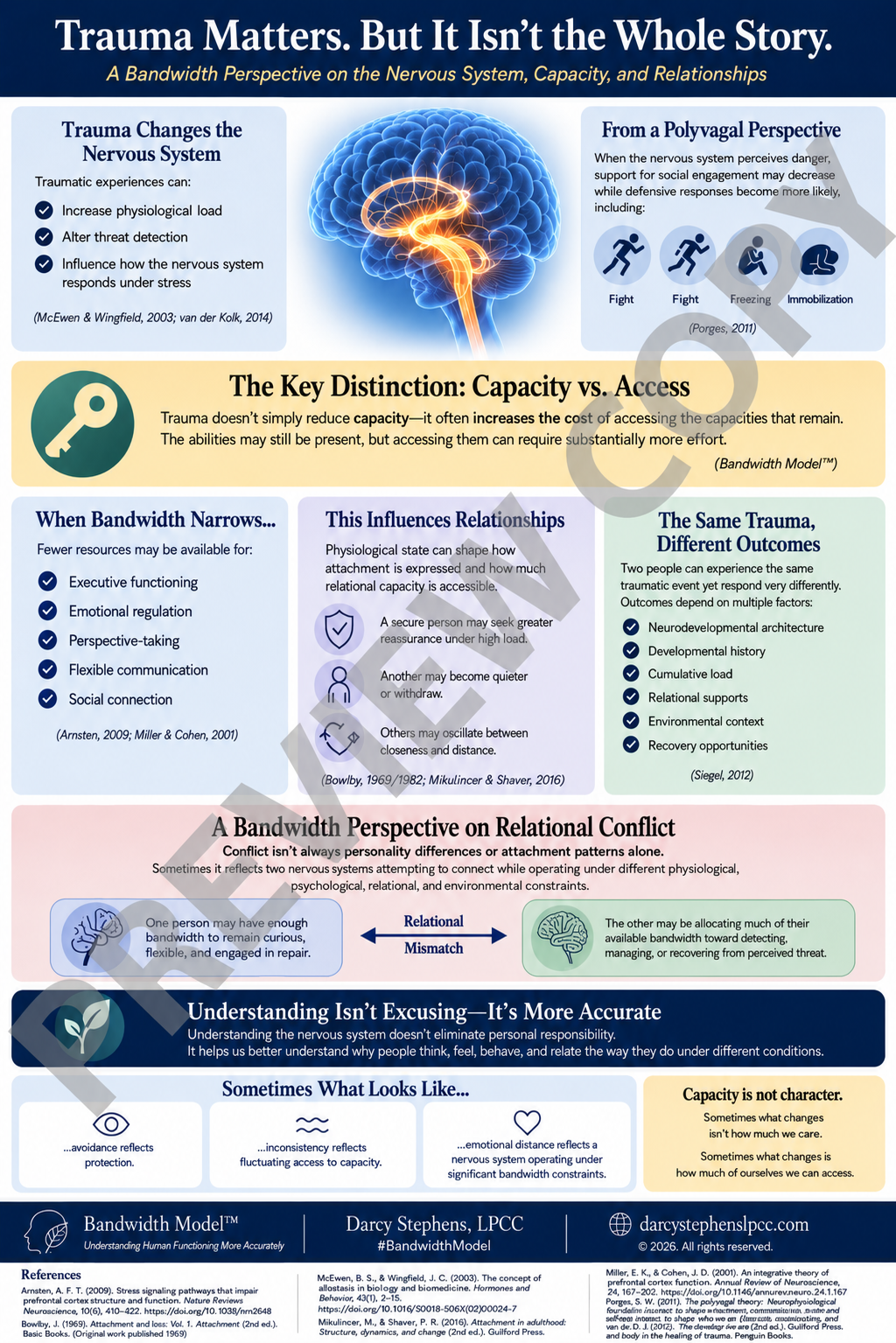
Attachment is not a personality type. It is the nervous system’s strategy for regulating when internal bandwidth is insufficient.
This infographic is designed for:
Mental health professionals
Educators and clinicians
Graduate students
Neurodivergent and trauma-informed communities
Anyone interested in attachment, relationships, and nervous system regulation
Educational resource only. This infographic reflects the Bandwidth Model™, an evidence-informed conceptual framework integrating research on attachment theory, stress physiology, executive functioning, and nervous system regulation. It is intended for education and discussion and is not a diagnostic or treatment tool.
Attachment Is a Bandwidth Strategy: How the Nervous System Uses Relationships to Regulate Under Stress explores attachment through a nervous system and capacity-based lens. Rather than viewing attachment patterns as fixed personality traits, this infographic explains how attachment behaviors can emerge as adaptive regulation strategies when internal bandwidth becomes limited.
This resource illustrates how increasing stress load can narrow executive access, increase the need for external regulation, and activate attachment strategies designed to manage the balance between cost and support. It reframes attachment from “who someone is” to how a nervous system attempts to maintain safety and regulation under changing conditions.
Inside you'll explore:
Why attachment is a biological regulation system rather than simply a personality characteristic.
How stress and reduced internal regulation capacity activate attachment behaviors.
The central attachment question:
“Is support available, predictable, and worth the cost?”
How secure, anxious, avoidant, and disorganized attachment strategies can be understood as adaptations to different relational environments.
The difference between attachment strategies and identity-based labels.
How increased bandwidth allows greater flexibility, connection, and healthier regulation strategies.
Attachment strategies are presented as:
Secure — Support is reliable and safe
Seeks support when needed.
Accepts comfort and co-regulation.
Returns to independence efficiently.
Anxious — Support is inconsistent
Amplifies signals for connection.
Monitors relational availability.
Attempts to reduce uncertainty.
Avoidant — Support is costly or unavailable
Conserves emotional resources.
Minimizes dependence.
Relies heavily on self-regulation.
Disorganized — Support is both needed and feared
Experiences competing approach/avoid responses.
May shift between seeking and withdrawing.
Reflects disrupted safety learning.
The Bandwidth Model™ takeaway:
Attachment is not a personality type. It is the nervous system’s strategy for regulating when internal bandwidth is insufficient.
This infographic is designed for:
Mental health professionals
Educators and clinicians
Graduate students
Neurodivergent and trauma-informed communities
Anyone interested in attachment, relationships, and nervous system regulation
Educational resource only. This infographic reflects the Bandwidth Model™, an evidence-informed conceptual framework integrating research on attachment theory, stress physiology, executive functioning, and nervous system regulation. It is intended for education and discussion and is not a diagnostic or treatment tool.